
Feels like snow is in the air. Certainly there are a few little snowflakes in the garden.
 After yesterday's heavy rain, cheer the office up with a bunch of colourful proteas from the Adderley Street flower sellers. John Ruskin said, "Flowers seem intended for the solace of ordinary humanity" and I am just such an ordinary human.
 Red seems to be the main colour of February. We hiked up onto Table Mountain to see the Red Disas - and saw these Red Crassulas and red Sunshine Conebushes too. You can see Lion's Head in the distance - and the upper cable station of Table Mountain on the right.
 The Golden Spiderhead (Serruria villosa) is a type of protea that occurs only on the Cape Peninsula. We hiked up Trappieskop which is near Kalk Bay today, and found several large bushes of them on the top. You can see False Bay in the distance.
 This is a Painted Lady (Gladiolus carneus), a common lady indeed, growing from the Cederberg all the way round the south-western Cape to Plettenberg Bay. Snapped on a misty morning on Table Mountain, near the entrance to Cecilia Forest off Rhodes Drive, this one was displaying its frilly stigma, with protruding anthers dangling provocatively hoping to attract the attention of a passing bee or fly pollinator. Those pretty spade markings on the petals too are "nectar-guides" to draw a pollinator's attention to the nectar hidden within the flower.
 Our hike this morning took us from Simonstown up onto the mountain to Swartkops Peak and along the spine of Table Mountain and down to Smitswinkel Bay - a most spectacular five and a half hours. On the way we passed the famous Swartkops Spiderhead population - the only one left of these beautiful spiderheads - Serruria hirsuta.
  They are listed as Critically Endangered on the internationally endorsed IUCN Red List Categories and Criteria in the Red List of South African plants. The genus Serruria belongs to the protea family and was named in honour of J. Serrurier who was Professor of Botany at the University of Utrecht in the early eighteenth century. The most famous one is the Blushing Bride, Serruria florida from Franschhoek.
 This delightful house is the home of the Director of the South African Astronomical Observatory in Observatory, on the banks of the Liesbeek River. Several rare and endangered species grow wild in front of the house which is on a remnant of "Peninsula Shale Renosterveld" vegetation.
  The Blue Peacock Moraea (Moraea aristata) that does well in cultivation but is almost extinct in the wild and only occurs naturally here.
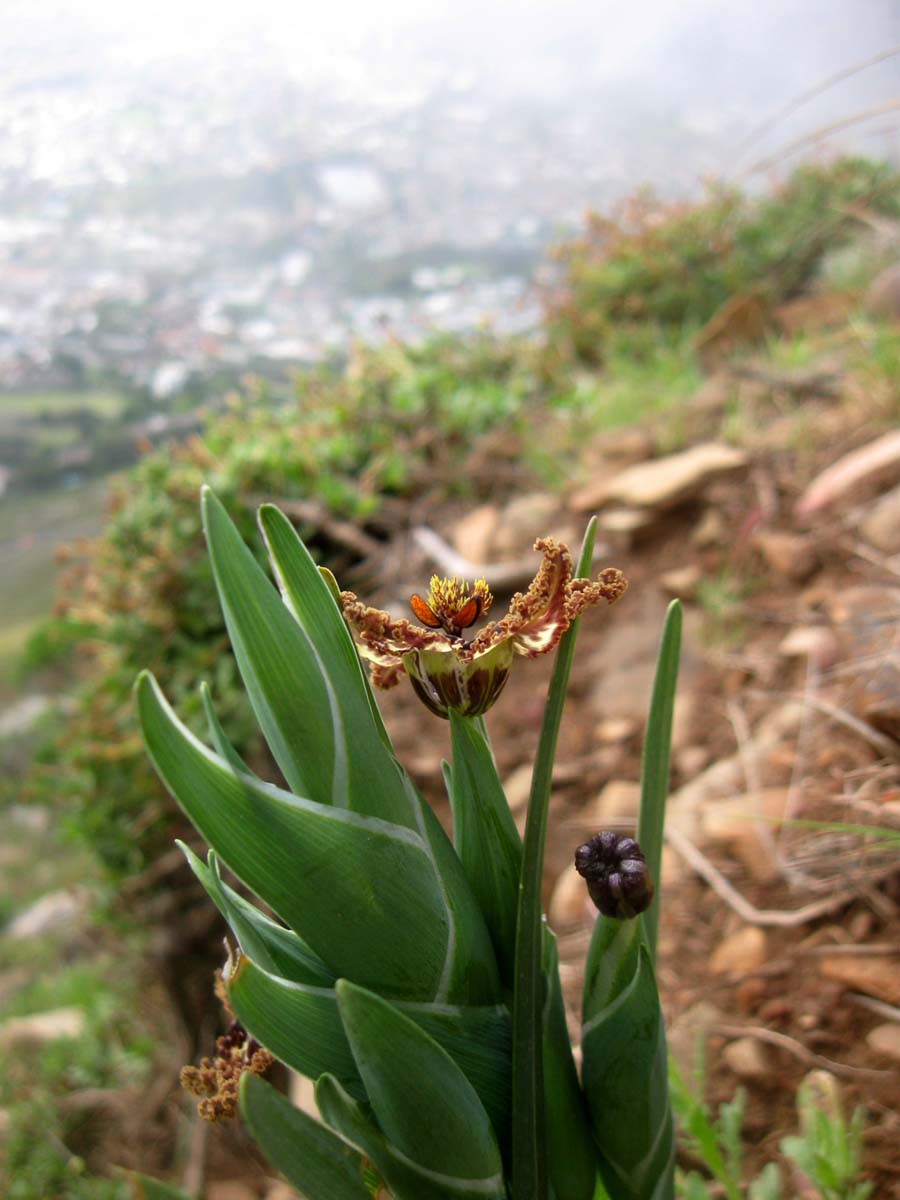 Up on Lion's Head this morning I saw this Ferraria crispa flower - also known as the Spider Iris. Its odd shaped, brown, mottled petals are adapted to look like flesh as the main pollinators are various types of fly - inlcuding Flesh Flies (Sarcophaga haemorrhoidalis) that lay their eggs in rotting flesh and faeces. It smelled a bit like vanilla. The flowers are about 3 cm across and the whole plant about 20 cm high.
 For more fun f posts, click the f.
 The road to Pofadder was lined with flowers - daisies and delicate blue, fragrant Heliophila flowers all enjoying the winter sun. The generic name heliophila means "sun-lover".
 Every year May is heralded by the appearance of these marvellous Paintbrush flowers (Haemanthus albiflos) in our garden. They are indigenous to South Africa and grow extremely easily in shady spots - in pots or not.
 This pretty unusual protea photographed this morning in perfect autumn weather is the Black-bearded Sugarbush (Protea lepidocarpodendron) that grows on Table Mountain and one or two places in the southwestern Cape but nowhere else. It is abundant on Table Mountain and our boys used to call it the "Hot Chocolate Protea".
 A very welcome misty, rainy morning. This is Nerine sarniensis, one of our beautiful indigenous bulbs, growing on the very top of Table Mountain just near the Mountain Club hut. It grows only on rocky mountain slopes in the southwestern Cape, although its common name is the Guernsey Lily because, for some reason, they were found growing on the Channel Island of Guernsey in the 1650s and legend has it they were washed up when a ship from the Cape, bound for Holland, was wrecked off Guernsey. That legend has been debunked though, and it is probably more likely that some amateur horticulturist wasn't very careful about where he or she planted their exotic bulbs. Oliver Cromwell's Major-General John Lambert is widely credited with being the culprit becuase he was known to have specimens of it in his garden in Wimbledon. He was exiled to the island of Guernsey after the Restoration, and it is thought, took some bulbs with him to while away the time.

 These narcissus potplants are flying off the shelves at Pick n Pay - everyone wants to celebrate spring because its Easter. I wonder how the plants are tricked into thinking its spring in the middle of autunm? (And today has reverted to summer at a scorching 30 degrees!)
 The seasons march on - and the March Lilies are coming up all over Cape Town - especially along the M3 from Constantia to town. A reminder that Autumn is almost here.
  Just returned from a long weekend in the Cederberg mountains, three hours drive from Cape Town, where I was lucky enough to find a few of these interesting little flowers growing in the sandy veld near our cottage. They are kukumakrankas (Gethyllis verticillata) and their tiny, dainty flowers were out there in the baking midday sun with temperatures over 40 degrees Celsius! (They are about 10 cm high.)
 This morning was raining softly and Table Mountain was shrouded in mist. We went for a walk up Devil's Peak and came across this beautiful Aristea macrocarpa all wet with rain and festooned with spider's webs. It is a member of the Iris family (Iridaceae) but doesn't seem to have a common name.
 Xiphotheca fruticosa - the Silver Pea bush that grows on Table Mountain. This unusual bush grows in profusion on the slopes of Chapman's Peak overlooking the Cape Town suburb of Noordhoek, Long Beach and Kommetjie in the distance. It flowers from April to September.
 You can't win 'em all and last night's soccer was a tad disappointing - but fun to get let loose in the Cape Town Stadium again. We lost to the USA by a goal, but had fun "painting the town yellow" in support of Bafana Bafana.




 Cape Town Time