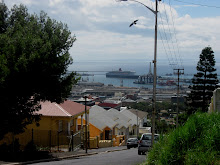
Icy cold winds and a frothy Fish Hoek this morning.


 Cape Town Time
11 years ago
 Seen on the beach at Fish Hoek yesterday morning: a little hermit crab in a plough snail shell. It looks like it could be a Pink Hermit (Paguristes gamianus) and I will post it on the wonderful iSpot website and see if one of the experts agrees. It has been quite stormy here so maybe it got washed off the rocky shores that it prefers as it is not usually seen on the beach.
 This large clam is the Smooth Trough Shell (Mactra glabrata) that often washes up on Fish Hoek Beach. While alive, the clam burrows just below the surface of the waves in fine sand and like most bivalves, it is a filter feeder - sucking water through an inhalant siphon, sieving it through sheet-like gills, and then expelling the waste water through an exhalant siphon. Much of the body consists of gonad and enormous amounts of egg and sperm are shed into the water where they develop into planktonic larvae.
 After all the rain yesterday, the Silvermine River was coming down in full spate, and it seemed like these little crabs had been washed down the river out to sea, then back onto the sandy beach. I think it must be the Sandflat Crab (Cleistostoma edwardsii). It's carapace is less than 1 cm wide, but with that huge shadow, it looks quite ferocious!
 This morning's walk on Fish Hoek beach revealed lots of kelp washed up after last night's storm. Many of the kelp stipes were encrusted with barnacles which are the most fascinating creatures. They are highly modified crustaceans and this is their adult phase. After swimming around the ocean as planktonic larvae, the adults settle down, head first, and cement themselves to a substrate, secreting a shell and extending their legs (or cirri) through a hole at the top to filter out food particles. I think this one might be the White Dwarf Barnacle (Notomegabalanus algicola).
 Chalky cuttlebones are a familiar sight on beach high tide lines in South Africa. As a kid I remember collecting them for my budgies. They are the internal skeletons of cuttlefish, members of the Cephalopodia (a Greek word meaning "head feet") class of mollusc that include squid, octopuses and cuttlefish -certainly the most sophisticated invertebrates around today. Their ancestors used to dominate the waters of the prehistoric ocean - everyone has heard of ammonites and belemnites; and there is even a legendary kraken.
 This week's Fish Hoek walk revealed a few Three-Spot Swimming Crabs (Ovalipes trimaculatus) washed up on the high tide mark. These crabs live in the turbulent surf zone on sandy beaches and eat bivalves and gastropods, particularly Plough Snails (Bullia). They can swim, as their hind limbs which have "paddles" on them indicate, but they also scuttle across the sand, and bury themselves in the sand - backwards first - when threatened.
 Washed up on Fish Hoek Beach this morning: a small, round, puffed up little fish called a 'blaasop', which is Afrikaans for "puffed up". It is a Birdbeak Burrfish (Cyclichthys orbiculatis) that normally lives in the open ocean (Indian and Pacific). Juveniles are often washed up on Cape beaches. Its spines are modified scales.
  Today's walk on Fish Hoek Beach revealed a dead Cape Fur Seal pup, washed up and looking for all the world like it was relaxing on the beach. These are our most common seals, and they breed on islands along the coast. The pups are at a crucial stage in their lives as it round about now that they have to learn to fend for themselves. The high seas that have occurred lately must have proved too much for this poor pup.
 This Friday's beachcomb revealed lots of By-the-wind Sailors (Velella velella) cast up on Fish Hoek Beach. Each one is actually a colony of polyps that eat plankton and other microscopic life of the open ocean. They are related to jellyfish and bluebottles; and have stinging cells to catch their prey, but unlike bluebottles, they are harmless to humans. In this photo you can see the transparent sail that propels the little floating colony across the ocean. Absolutely amazing!
 Another weird creature of the open ocean cast up on Fish Hoek Beach: a Sea Swallow (Glaucus atlanticus) - a gastropod mollusc that has lost its shell. It is about 20 cm long, and according to George Branch's book Two Oceans, it floats upside down on the surface of the open ocean, gulping air to keep it afloat and feeding on Bluebottles and their relatives. It can utilize the stinging cells of their prey for their own defence.
  So this is how it would look to us looking down on it from the air.
 Today is blowing a gale in Cape Town, but that didn't stop us from taking the dogs for a windy walk on Fish Hoek Beach. The Southeaster had cast all manner of life up onto the beach like this Bluebottle (Physalia physalis) and Violet Snail (Janthina janthina): prey and predator.
 Darwin was fascinated by barnacles and this in one of the barnacles he studied - the Buoy Barnacle (Dosima fascicularis) which has washed up on Fish Hoek Beach in great numbers.
 Another Violet Snail or Bubble Raft Shell - a gastropod that floats on the open ocean using mucous-coated bubbles that it secretes from its foot. It eats bluebottles.
 A deserted and windswept Fish Hoek - with the car park rapidly filling up with sand. Tomorrow I hear the weather will be utterly perfect.