Showing posts with label Cape Point. Show all posts

Wednesday, April 18, 2012

Gone shark fishing

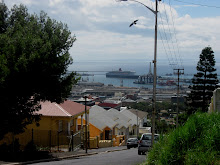
A lone fishing boat in False Bay seen from Cape Point. At the far end is Muizenberg peak.
Actually it might look like a fishing boat, but it is a shark research vessel for Ocearch which is rather controversial as they use chumming (throwing bait into the water) to attract sharks for filming and tagging, and many people are totally opposed to this practice of interfering with nature as, they rightly point out, the behaviour of all wild animals is modified by humans feeding them. They become habituated to the feeding and end up becoming a nuisance to humans - caused by humans in the first place. But they have a permit from the authorities ...

Sunday, April 15, 2012

Hitching a ride

A major attraction at Cape Point is the baboons. This statue at Cape Point, close to the restaurant, aims to inform visitors about these animals and reminds them not to feed them - which is something that humans find incredibly difficult. What it this urge to feed animals? An interesting website to visit is Baboon Matters.

Monday, February 13, 2012

In the bush on the beach

Olifantsbos guest cottage in the Cape Point section of the Table Mountain National Park is yours for the night if you can afford R2640 (self catering). Admittedly that is for six people, and you can fit more in too, for a smaller fee per head. But what a fabulous, isolated spot. A word of warning though - it does get rather wild and windy in the summer.

Wednesday, January 4, 2012

Down memory lane

The old homestead at Cape Point, now called Buffelsfontein Visitor Centre, used to be a restaurant when I was a kid - a restaurant that served a pretty good blueberry tart. How well I remember these trees and the whole "feel" of it from those exciting holiday visits! Even further back the homestead belonged to a chap called John McKellar from 1855-1886 and it was during his ownership of the farms Buffelsfontein and Uiterstehoek that (the display states) Charles Dickens paid a visit and stayed at this very homestead. (Ooops, sorry, Charles Dickens never set foot in South Africa - it was Charles Darwin. Maybe I need specs!) George Smith bought the farm from McKellar in 1886 and it became known as "Smith's Farm". Apparently they made a livelihood from keeping stock, ostriches, producing and selling lime from the calcareous travetine outcrops along the coast, fishing and whaling. When the Smiths eventually had to sell the land, it was very nearly sold to a company that wanted to develop it as a holiday destination, but thanks to the efforts of Norman and George Smith who were anxious that their land should become a nature reserve, and some forward thinking Capetonians - including the architect Brian Mansergh, the Hare family, Cape Divisional Councillor C.W.T Duminy and the naturalist S.H. Skaife - the land was eventually - and after a long struggle - declared a nature reserve by the Cape Divisional Council in 1939. It was incorporated into the Cape Peninsula National Park in 1998; which then became the Table Mountain National Park in 2004.
But visit the Buffelsfontein Centre and its classy displays, and learn all about this amazing place for yourself.

Tuesday, September 27, 2011

Getting to the Point


Looking down over Smitswinkel Bay which gets its name, "the blacksmiths shop" from some rocks that resemble an anvil and bellows and not from some hermit blacksmith that set up shop in this remote spot. The few beach cottages down there are highly desirable and seldom come onto the market. The beach is right on the edge of the Cape Point section of the Table Mountain National Park. Cape Point can be seen in the far distance too.

Friday, September 24, 2010

Cape Point

Today is Heritage Day - created for all South Africans to reflect on our predecessors. The Cape Point section of the Table Mountain National Park - where the Cape Peninsula peters out into the southern ocean - seemed like a good place to start reflecting. There is evidence of Early Stone Age humans with stone tools in sandy deposits dated to 600 000 years ago, and yet more evidence of the tool-makings of Middle Stone Age humans 200 000 to 40 000 years ago. Even more visible to visitors are midden and cave deposits with Late Stone Age shellfish meal remains, stone tools and bits of pottery and bone dating from 21 000 years ago to the arrival of the European explorers in the Fifteenth Century.
This photo shows an old Dutch cannon (found right here on the since-named Kanonkop in the early days of the First World War) which is thought to be the first in a signal chain to report ship arrivals in False Bay in the days of the Dutch East India Company rule - 1652-1795. It has been restored and mounted on an authentically built carriage, constructed to Dutch specifications.
Also just evident in the photo is the white Padraos of the Da Gama Monument (right, a quarter of the way down), marking the spot where Vasco Da Gama planted his padraos (cross) in 1497 for his king and country (the second coming of the Portuguese to this peninsula).